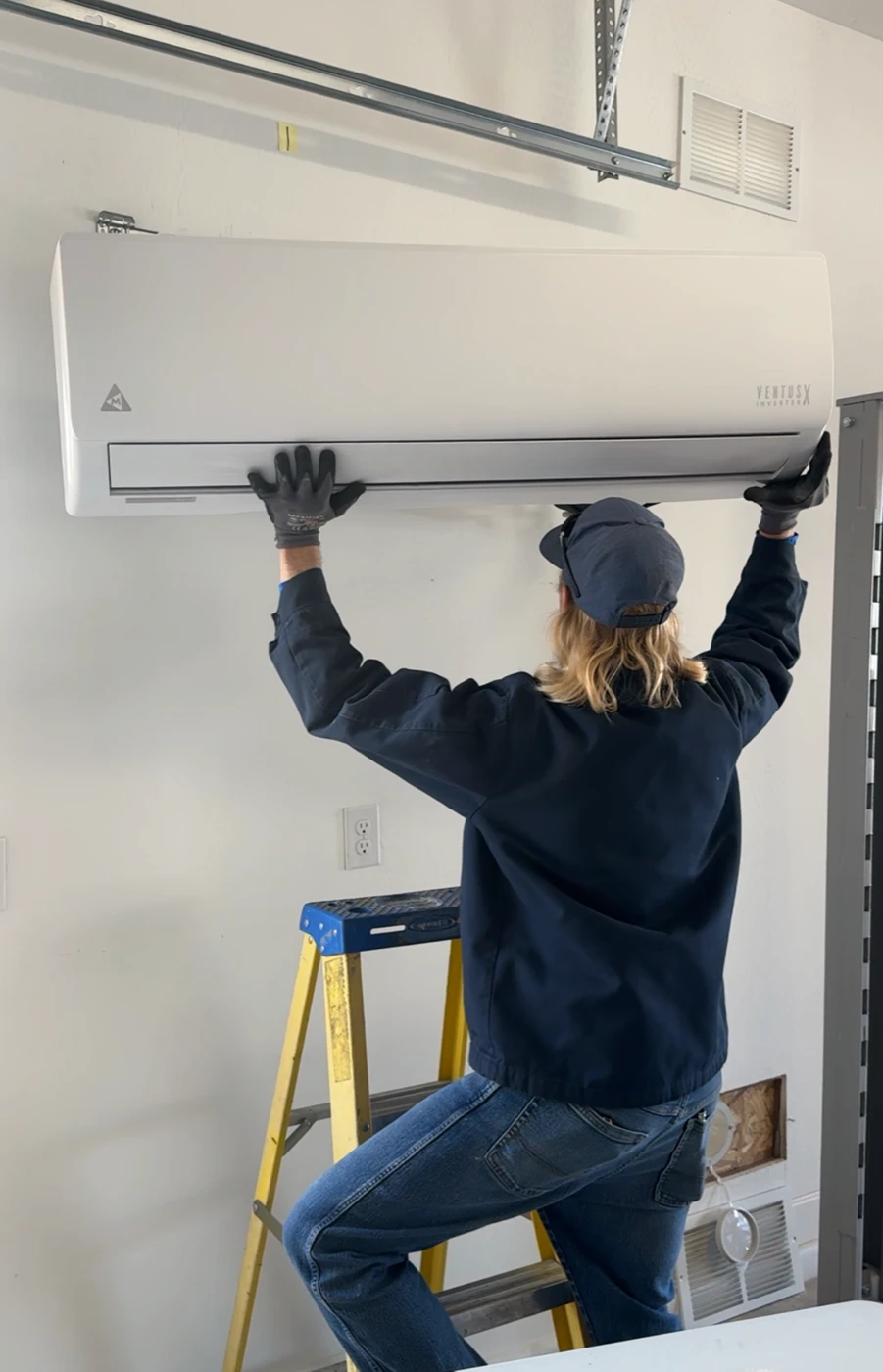
Garages break normal sizing rules. One giant uninsulated steel door facing the afternoon sun changes the math a national calculator will not account for.
By the AZ Insulation crew 9 min readUpdated August 2026 BPI-certified · ROC# 301682
Square footage is the starting point. The garage door orientation, insulation, air leakage, and what you do in there set the real number.
Quick answer
A typical 2-car Arizona garage of 400–500 square feet needs roughly 12,000–18,000 BTU. Uninsulated Arizona garages run about 30–40 BTU per square foot, versus around 20 BTU per square foot for conditioned living space. A load calculation determines the real number, because the garage door, exposure, and attic insulation change it significantly.
That is the number most homeowners in Mesa, Gilbert, Queen Creek, Goodyear, and Surprise are looking for. Now here is why the range is that wide, and how to figure out where your garage lands inside it.
Garages break normal sizing rules. A living room has insulated walls, an insulated ceiling, dual-pane windows, and neighbors on two sides. An Arizona garage often has one giant uninsulated steel door facing the afternoon sun, an uninsulated ceiling under a 150–160°F attic, and a concrete slab that stores heat all day and gives it back all evening. That is why we use a much higher BTU-per-square-foot starting point here than a national calculator will give you.
How many BTU do I need to cool an Arizona garage?
Use 30–40 BTU per square foot for an uninsulated Arizona garage and roughly 20–25 BTU per square foot for a well-insulated one. Multiply by your garage’s square footage, then adjust for the factors below.
Garage
Approx. sq ft
Uninsulated
Well insulated
1-car
240–300
9,000–12,000 BTU
6,000–9,000 BTU
2-car
400–500
12,000–18,000 BTU
9,000–12,000 BTU
3-car
600–750
18,000–24,000 BTU
12,000–18,000 BTU
RV bay / shop
800–1,000+
24,000 BTU+ or two heads
18,000–24,000 BTU
Starting points for planning and budgeting, not quotes. A Manual J load calculation and an on-site look set the real number.
Free · no obligation
Let us measure it and give you the real number.
We measure the garage, check the ceiling insulation, the door construction and the seals, add up the internal heat load, and size the equipment to the post-insulation load. Free, no obligation.
Five things move a garage up or down within its range, and in the Valley they move it a lot:
Which way the garage door faces. A west-facing garage door takes direct afternoon sun during the hottest hours of a Phoenix summer day. West- and south-facing garages regularly need the top of their range. A north-facing garage tucked behind the house often needs the bottom.
Whether the garage door is insulated. A raw single-skin steel door is the largest uninsulated surface in most Arizona homes. Adding an insulated door or a quality door insulation kit, plus new perimeter and bottom seals, can drop the required capacity by a full step.
What is above the ceiling. If there is attic space over the garage and it is bare or thin, you are cooling against 150–160°F. Insulating that ceiling plane is usually the highest-value change you can make before sizing anything.
What you do in there. A garage gym with two people working out, a welder, a compressor, a kiln, a second refrigerator, or a wall of tool chargers all add real heat load. So does parking a car that just came off the 202 in August.
How airtight the garage is. Gaps under the door, an unsealed man door, and open attic penetrations mean you are partly cooling the outdoors. Air sealing comes before equipment sizing every time.
If several of these stack — a west-facing, uninsulated door on a 2-car garage you use as a gym — you are at 18,000 BTU or beyond, and honestly, you should insulate before you buy anything.
Why is oversizing a mini-split a mistake?
Oversizing a mini-split is a real mistake, not a harmless safety margin. Three things go wrong:
Short-cycling. An oversized unit satisfies the thermostat fast, shuts down, and restarts a few minutes later. Frequent starts are the hardest thing a compressor does.
Poor moisture removal. Air conditioners dehumidify while they run. A unit that only runs in short bursts never pulls much moisture out — which matters more than people expect during monsoon season, roughly mid-June to late September, when a clammy garage means rusty tools and musty stored goods.
More wear and worse comfort. Short cycles mean uneven temperatures, more noise, and more wear on the compressor and the contactor over the life of the system.
Inverter-driven mini-splits handle oversizing better than old single-stage equipment, because they can modulate down. But they still have a minimum output, and a badly oversized unit will hit it. Right-sized beats oversized.
What about undersizing?
An undersized mini-split in an Arizona garage never reaches setpoint on a 115°F day. It runs at 100% all afternoon, your bill climbs, and the garage stays uncomfortable. That is the more common outcome when someone buys a bedroom-sized unit off a website for a 2-car garage.
The fix is not automatically a bigger unit. Often the cheaper fix is insulation: reduce the load, and the smaller unit that is already there starts winning.
Where the insulation actually goes: walls and attic
Two surfaces decide how big a unit your garage needs, and neither of them is the garage door. Above you is the attic plane. Beside you are the walls the builder almost certainly left empty.
Garage walls: drill and fill, no drywall removal
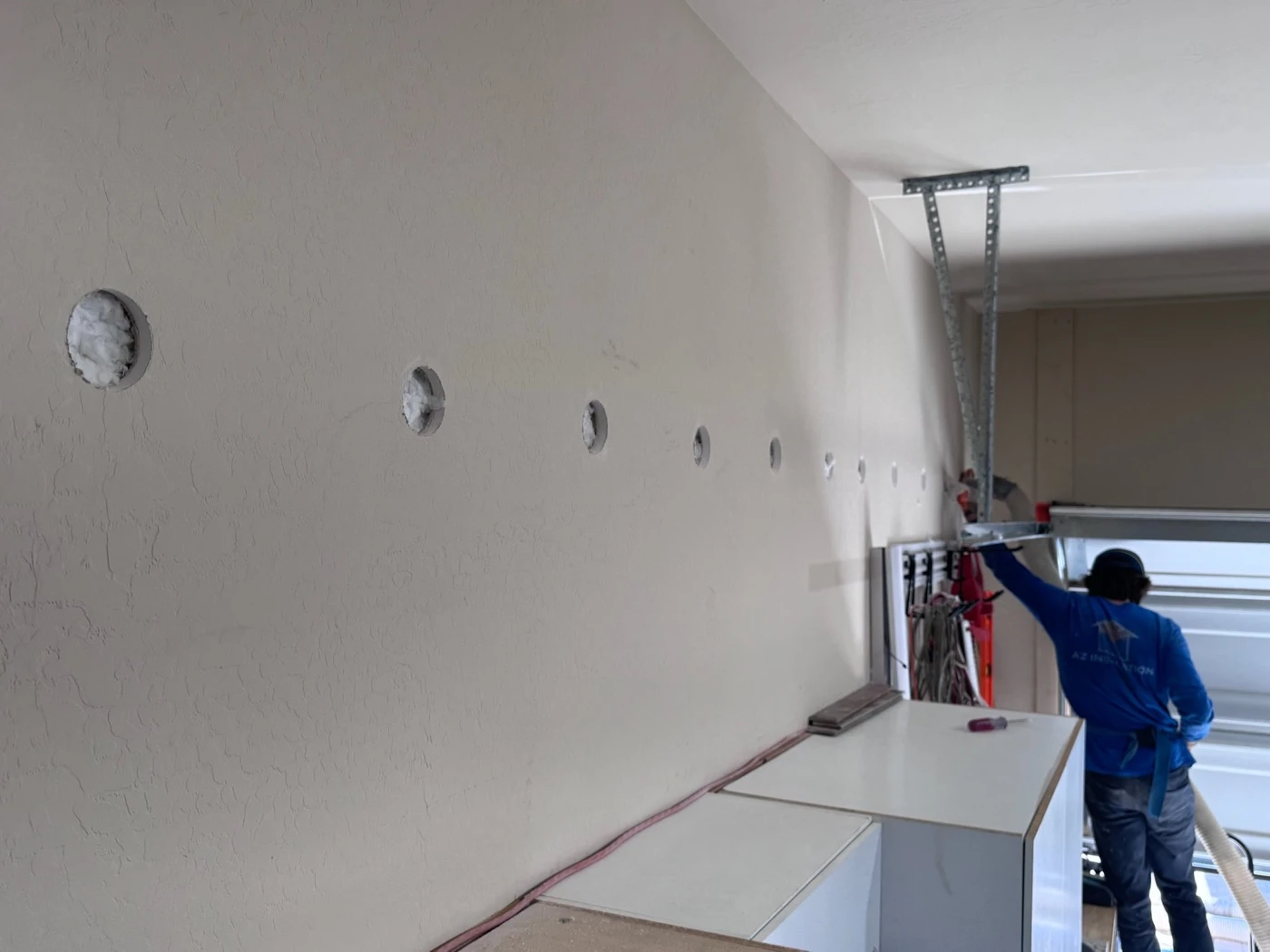
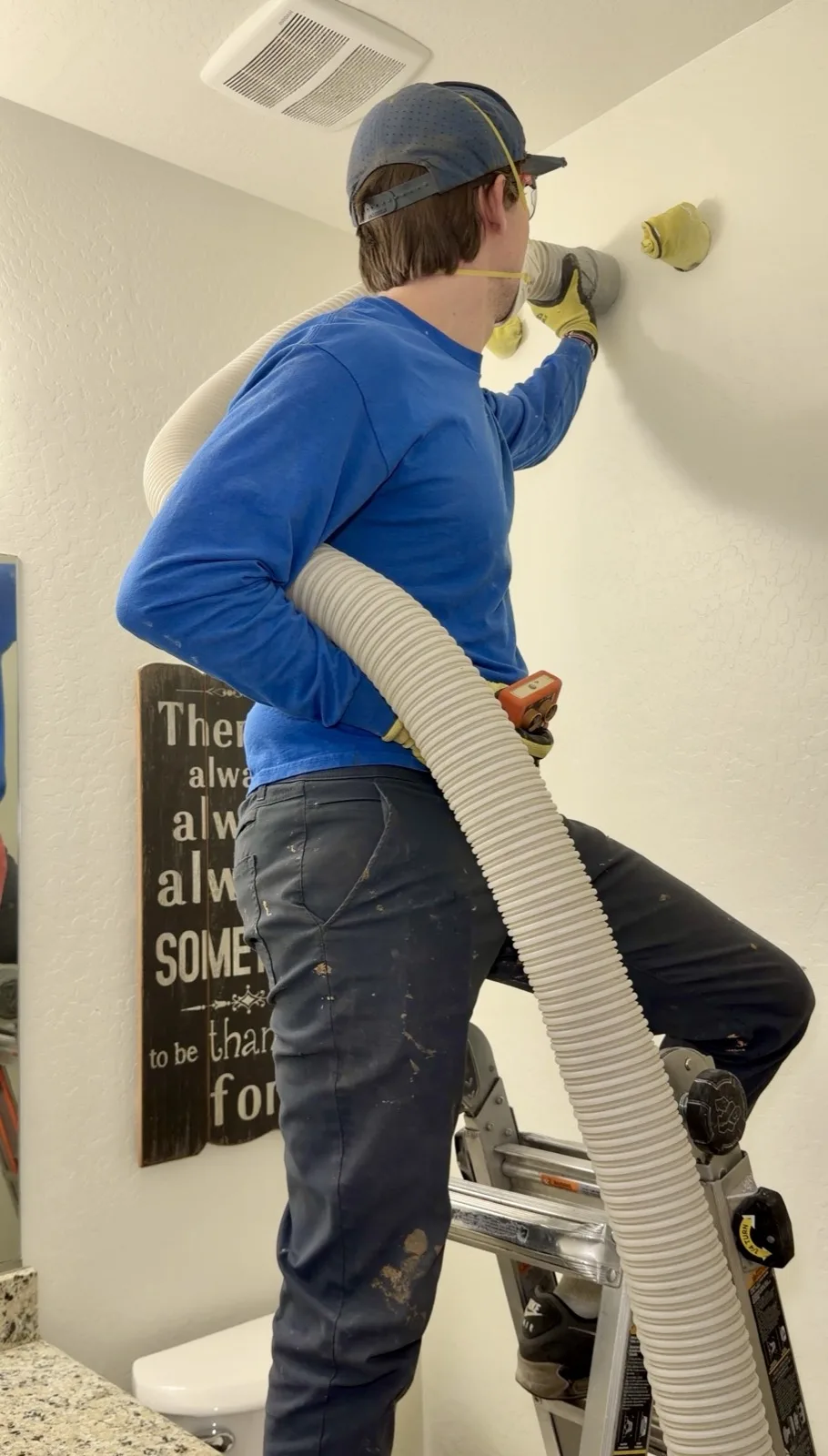
Most Arizona garages have bare wall cavities, including the wall shared with the house. We upgrade them without tearing out drywall: small 3-inch holes drilled between the studs, insulation dense-packed into each cavity, then the holes patched. A shared wall stops pulling heat into your living room, and an exterior west-facing wall stops acting like a second garage door. Drywall repair and paint are not included.
The attic plane: R-38, measured
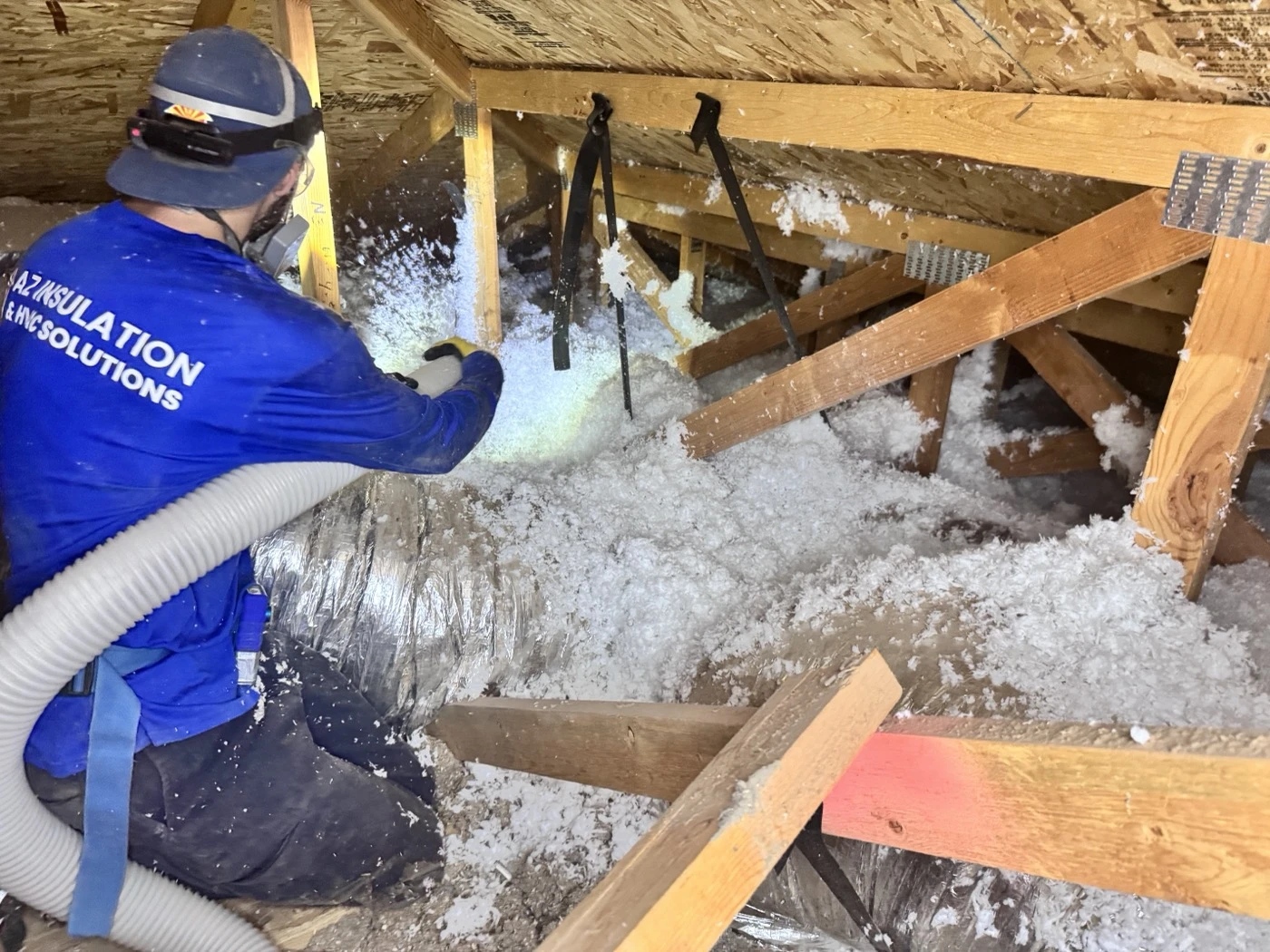
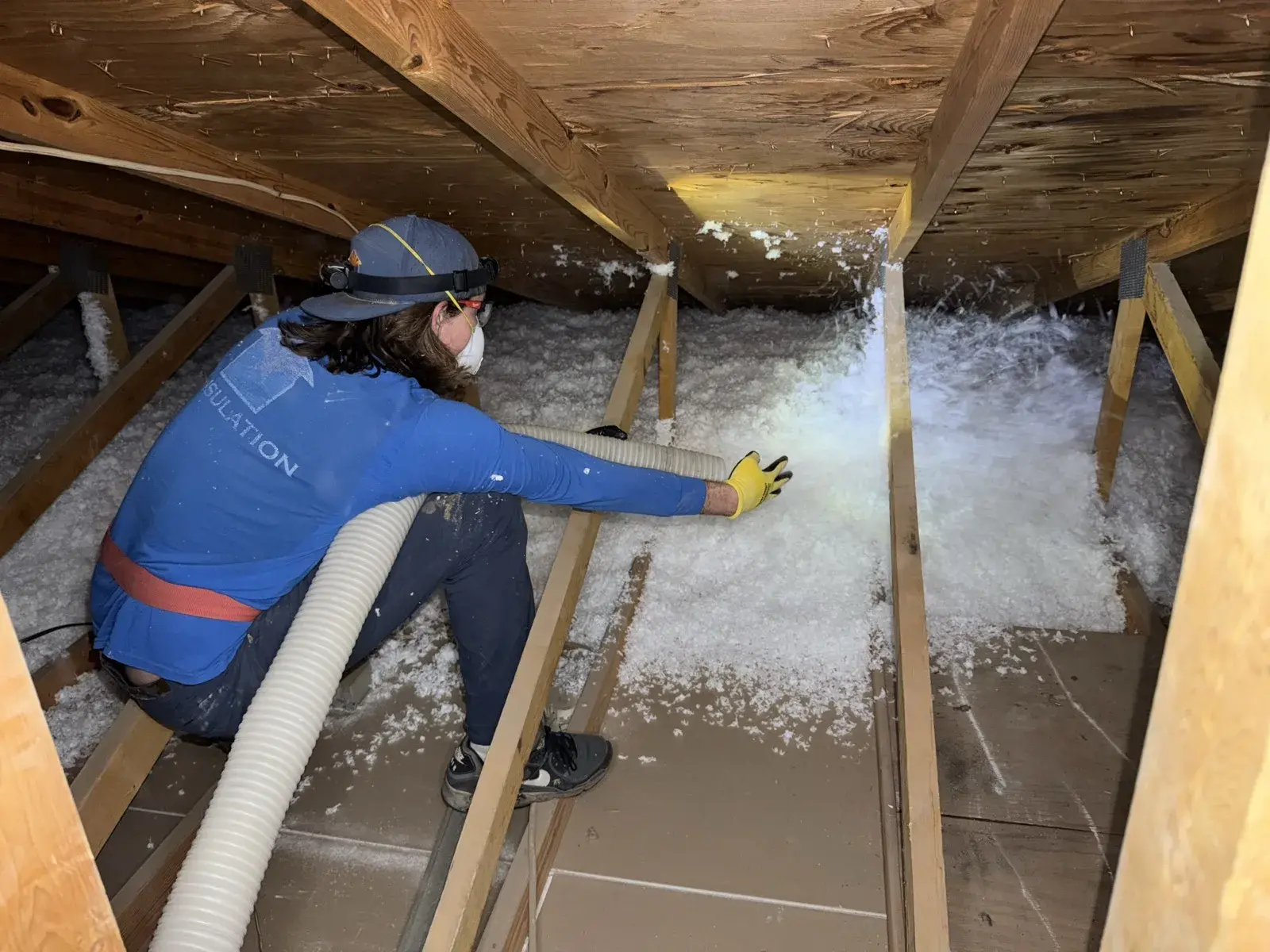
If there is attic space above the garage and it is bare or thin, the mini-split is cooling against 150–160°F all afternoon. R-38 is roughly 13–14 inches of blown fiberglass, and it is the level SRP’s rebate program sets for Valley attics. We blow it in around the trusses and the ductwork so there are no voids at the edges — the places that undo an otherwise good job.
Drill and fill on a garage wall — one small hole per stud cavity, dense-packed, then patched.
Blowing fiberglass in around the trusses and ducts — coverage at the edges is what holds the R-value.
Do these first and the sizing conversation changes: a smaller head, fewer run hours, and a lower bill for the same comfort. And while the crew is up there, an under-insulated main attic often qualifies for SRP’s residential insulation rebate — up to $600, covering up to 75% of professionally installed attic insulation, applied instantly on the invoice by a BPI-certified, Arizona-licensed contractor. Current as of publication. Wall insulation does not qualify for the rebate.
Up to $600 off
Insulate first and you may drop a whole size.
A thinner ceiling means a bigger unit. Bringing the attic to R-38 often moves you down a size — and SRP covers up to $600 of the insulation, applied instantly on your invoice.
Is a 12,000 BTU mini-split enough for a 2-car garage in Arizona?
A 12,000 BTU mini-split is often enough for an insulated 2-car garage in Arizona, and often not enough for an uninsulated one. At 400–500 square feet and 30–40 BTU per square foot, an uninsulated 2-car garage lands at 12,000–18,000 BTU. Insulate the ceiling and door first, and 12,000 becomes realistic.
Do I size a garage mini-split by square footage or by load?
Size a garage mini-split by load. Square footage is the starting point, but in Arizona the garage door orientation, door insulation, ceiling insulation, air leakage, and internal heat sources change the requirement substantially. Two identical 450 square foot garages on the same street can need different capacity depending on which way they face.
Does ceiling height change garage mini-split sizing?
Yes. BTU-per-square-foot rules assume roughly 8 to 9 foot ceilings. A garage with a 12-foot ceiling, an RV bay, or an open truss space above holds much more air volume and typically needs additional capacity. Tell your installer the ceiling height when you ask for a quote.
Should I get one bigger mini-split head or two smaller ones for a big shop?
For an oversized shop or RV garage, two smaller heads often outperform one large head, because a single head struggles to distribute air across a long or L-shaped space. Two heads also let you condition only the half you are working in. A multi-zone condenser can serve both.
Can a mini-split keep an Arizona garage at 72 degrees in July?
A right-sized mini-split in an insulated Arizona garage can hold a comfortable working temperature through a July afternoon. Chasing 72°F in an uninsulated garage on a 115°F day is how systems get oversized and bills get ugly. Most homeowners find that an insulated garage in the high 70s feels genuinely great.
Free · no pressure
Let Us Give You the Real Number
We will measure, check the envelope, and tell you if insulation gets you most of the way there for less money — then size the mini-split to the post-insulation load, not the bare-garage numbers.

 By the AZ Insulation crew 9 min read Updated August 2026 BPI-certified · ROC# 301682