

Spray foam insulation in Arizona: how it works, where it pays off, and when fiberglass is the better choice
Spray foam is one of the most effective insulation products available, but it is not the right answer for every part of every house. Here is how it works, the difference between open-cell and closed-cell foam, where it earns its cost in a Phoenix-area home, and where blown-in fiberglass is the smarter buy.
What is spray foam insulation?
Spray foam is a liquid insulation that is sprayed onto a surface, expands into a foam within seconds, and hardens in place. Because it expands, it fills cracks, gaps and odd-shaped cavities completely, so it insulates and air seals in one application.
That second part is what separates foam from other insulation. Fiberglass and cellulose slow heat moving through them, but air can still leak around them. In an Arizona home, air leaks through the ceiling and walls pull 150–160°F attic air and hot outdoor air into the house all afternoon. Foam stops the heat and the air leak at the same time.
Open-cell vs. closed-cell spray foam
Open-cell foam is lighter, softer and less expensive, and it is excellent for air sealing and sound control. Closed-cell foam is denser, has roughly twice the R-value per inch, and adds rigidity and a moisture barrier.
| Open-cell foam | Closed-cell foam | |
|---|---|---|
| Typical R-value per inch | About R-3.5 to R-3.8 | About R-6 to R-7 |
| Feel | Soft and spongy | Rigid and hard |
| Expansion | Expands a lot, fills large cavities | Expands less, applied in thinner passes |
| Air sealing | Excellent | Excellent |
| Moisture | Lets water vapor pass through | Acts as a vapor retarder at full thickness |
| Sound control | Very good | Good |
| Adds strength | No | Yes, stiffens walls and roof decks |
| Relative cost | Lower | Higher |
For most Arizona rooflines and interior walls, open-cell foam is the common choice. It gives a lot of air sealing and sound control for the money, and our dry climate means moisture control is rarely the deciding factor. Closed-cell foam makes sense where space is tight and you need the most R-value per inch, on metal buildings, on rim joists, and anywhere you want the foam to add rigidity.
Where does spray foam make the most sense in an Arizona home?
Spray foam earns its cost where air sealing matters as much as R-value, and where other insulation is hard to install well.
- Rooflines and unvented attics. Foam applied to the underside of the roof deck turns the attic into a semi-conditioned space. Your ducts and air handler stop sitting in a 150°F attic, which can make a large difference in how much cooling actually reaches your rooms.
- Garage walls and ceilings. Garages have lots of gaps and penetrations. Foam seals them and makes a garage gym, workshop or conversion far easier to cool.
- Room additions and casitas. New framing that is open now is the ideal time to foam it. It is far harder to do once the drywall is up.
- Metal buildings, shops and RV garages. Closed-cell foam sticks directly to metal, stops condensation and adds rigidity.
- Rim joists and band joists. A common air leak in two-story homes that batts never seal well.
- Bonus rooms over garages. Foam seals the floor and knee walls where these rooms lose the most heat.
- Hard-to-reach cavities. Sloped ceilings, cathedral ceilings and tight spaces where blown-in insulation cannot get full coverage.
Is spray foam better than blown-in fiberglass for an Arizona attic?
For a standard vented attic floor, blown-in fiberglass is usually the better value. Spray foam is the better choice when you want to insulate at the roofline instead of the attic floor.
Most Valley homes have a vented attic with insulation on the attic floor. In that setup, topping up with blown-in fiberglass to R-38 delivers most of the benefit for a fraction of the cost of foam, and it may qualify for the SRP attic insulation rebate. We install both, so we do not have a reason to steer you toward one.
Foam at the roofline makes sense when your ductwork and air handler are in the attic and you want them out of the heat, when the attic is being converted or finished, when the ceiling below has too many penetrations to seal well, or when the roof has no room for deep blown-in insulation, like a low-slope or cathedral roof.
| Situation | What we usually recommend |
|---|---|
| Standard vented attic, insulation on the floor | Blown-in fiberglass to R-38 |
| Ducts and air handler in a hot attic | Spray foam at the roofline |
| Garage you want to use year-round | Spray foam or fiberglass, depending on walls and budget |
| Room addition with open framing | Spray foam |
| Metal shop or RV garage | Closed-cell spray foam |
| Finished walls you do not want to open | Drill-and-fill wall insulation |
How spray foam helps in the Arizona heat
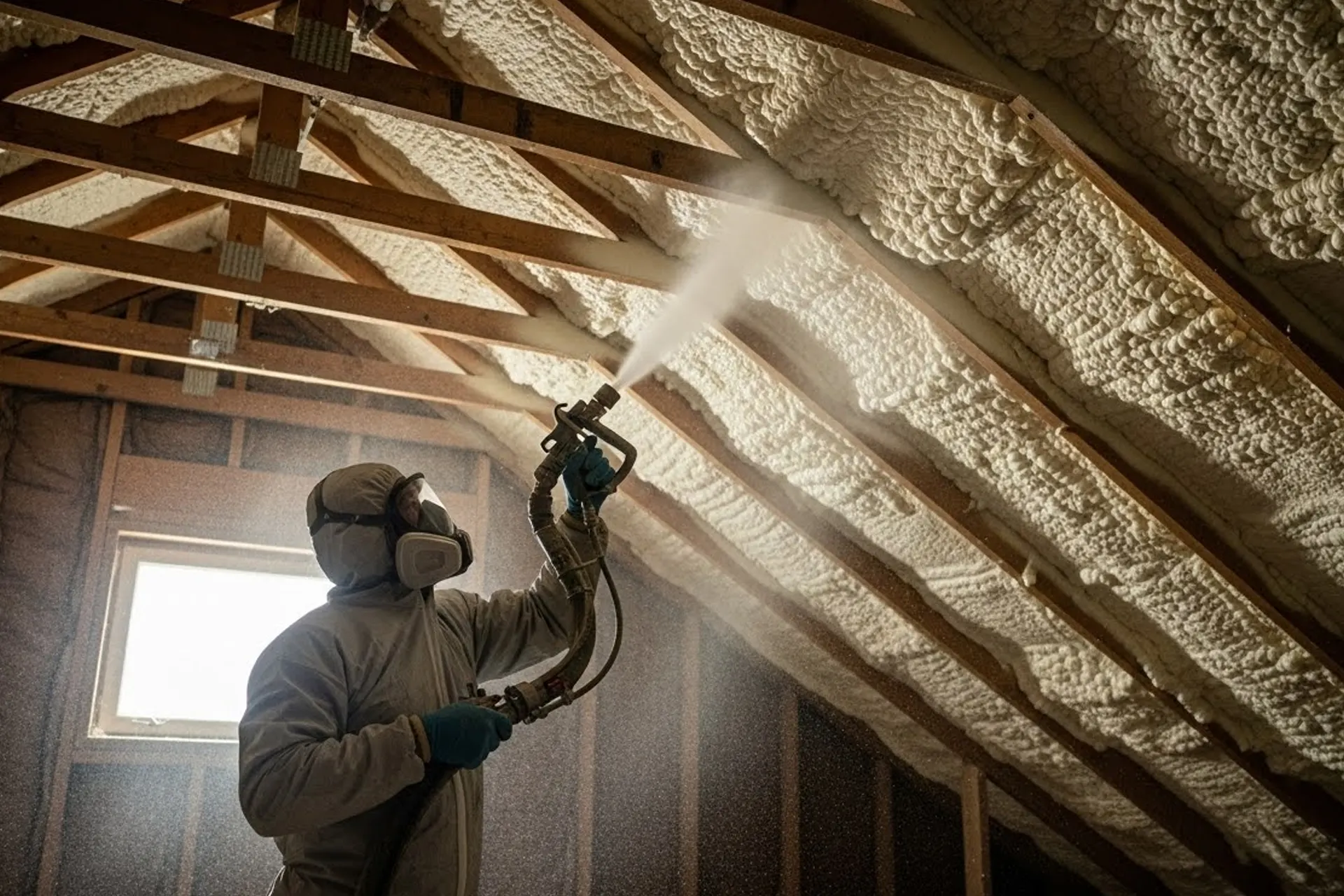
Phoenix-area attics are commonly 150–160°F on summer afternoons. When the ducts run through that space, the cold air from your AC warms up before it reaches the room, and any leak in the ductwork dumps cooled air into the attic. Moving the insulation to the roofline with spray foam keeps the attic much closer to the temperature of the house, so the ducts are not working against the heat.
The air sealing also matters for dust. Valley homes pull a lot of fine desert dust through small gaps in the ceiling and walls, especially during monsoon storms. Sealed with foam, those paths close.
Open-cell foam also reduces noise from traffic, neighbors and aircraft, which homeowners near busy roads and the airports often notice right away.
What affects the cost of spray foam?
Spray foam is priced by the area being covered and the thickness needed, so we quote every job after seeing the space. These are the main factors:
- Foam type. Closed-cell costs more per inch than open-cell.
- Square footage. A roofline, a garage ceiling and a set of rim joists are very different jobs.
- Thickness. More inches mean more material and higher R-value.
- Access. Low clearance, tight attics and tile roofs take more time.
- Prep and removal. If old insulation needs to come out first, that is part of the job.
- Code requirements. Foam in living spaces and some attics needs a fire-rated covering or coating, which we include in the quote when required.
We give you an itemized price before any work starts, and we tell you plainly when blown-in fiberglass would get you most of the benefit for less money.
How our spray foam installation works
Is spray foam safe?
Yes, when it is installed correctly. During application and for a period afterward, the foam releases vapors as it cures, so the area is kept clear and ventilated. Manufacturers set the re-occupancy time, which is typically about 24 hours for residential jobs. Once cured, the foam is inert. We explain exactly when you and your family can return before we start.
Signs your home could benefit from spray foam
- Rooms under the roof stay hot even after an attic insulation top-up.
- Your AC air handler and ductwork sit in the attic and the far rooms never cool down.
- Dust builds up quickly around vents, outlets and baseboards, a sign air is leaking in.
- You are adding a room, finishing a garage or building a shop and the framing is still open.
- You have a cathedral or low-slope ceiling with no room for deep blown-in insulation.
- Outside noise from traffic or aircraft comes straight through your walls and ceiling.
If two or more of these sound familiar, a free assessment will tell you whether foam, fiberglass or a mix of both is the right fix for your home.
Does spray foam qualify for rebates in Arizona?
It depends on the program and the project. The SRP attic insulation rebate has specific requirements for where the insulation goes and the R-value it reaches, and many spray foam projects, like garages and metal buildings, are outside what that rebate covers. Income-qualified households may also be eligible for Efficiency Arizona funding. We check which programs apply to your project during the free assessment and include any credits on your quote.
Spray foam installation across the valley
AZ Insulation & HVAC Solutions is a family-owned company based in Mesa. We install spray foam in Mesa, Gilbert, Chandler, Queen Creek, Tempe, Phoenix, Scottsdale, Glendale, Peoria, Apache Junction, Cave Creek, Gold Canyon, Goodyear and Surprise. Licensed, bonded and insured, ROC# 301682. Call 480-662-2874 or request a free assessment.